The Knowledge Trap: Why AI Can Read 761 Molecules but Can't Make a Single Decision
OpenAI's MedChemBench exposed the ultimate flaw of pure intelligence: 95.4% accuracy at understanding chemistry, but a coin-toss at deciding what to test next. Information is cheap; conviction is scarce.
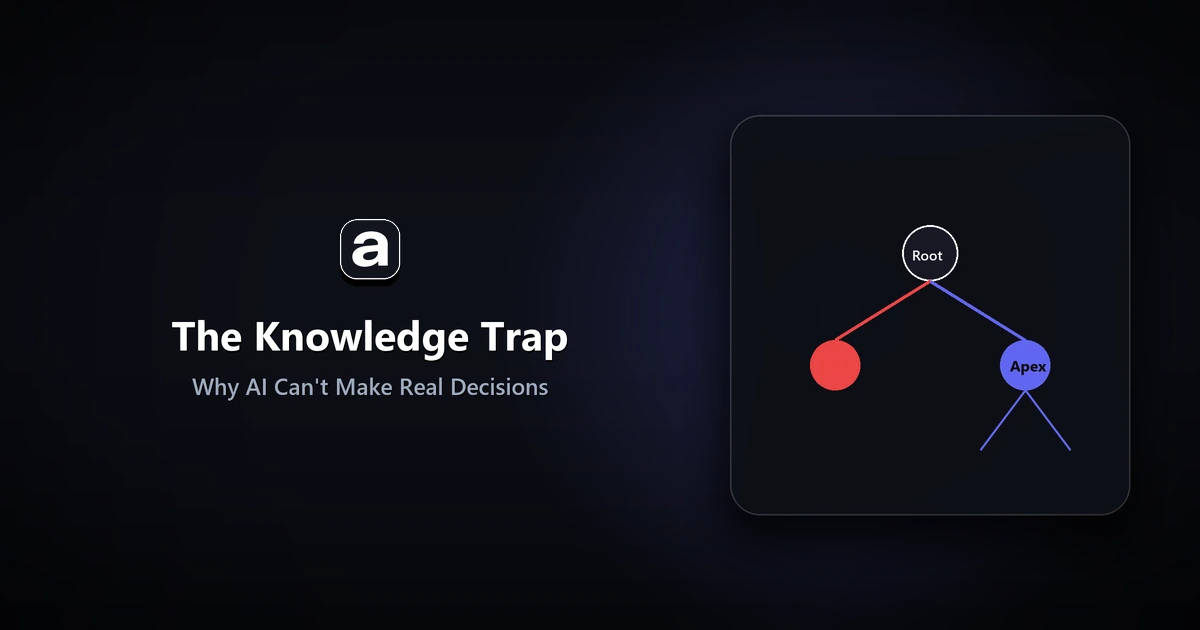
OpenAI's latest benchmark, MedChemBench, tested frontier LLMs on 99 real-world medicinal chemistry challenges drawn from 117 patents and 761 molecules. While GPT-6.2 Astra scored 95.4% at parsing molecular structures and historical assay data, its ability to choose which novel compound to synthesize next collapsed to barely 50%—proving that analytical comprehension does not equal discretionary decision-making.
Do You Know the Difference Between Knowledge and Judgment?
Think of someone you know who has read hundreds of business books.
They can quote Warren Buffett. They can draw five different frameworks on a whiteboard.
Yet, they haven't started a business. And when money is on the line, they freeze.
That exact same paradox just showed up inside the smartest AI in the world.
On November 20, 2026, OpenAI released a benchmark called MedChemBench.
They gave their top frontier model, GPT-6.2 Astra, 99 real-world drug discovery challenges involving 761 complex molecules.
Here is what happened:
- When asked to read, analyze, and explain molecular bonds: The AI scored 95.4%. It understood the data better than top PhD chemists.
- When asked the critical question—*Which compound should we test next?*—its accuracy plummeted to roughly 50%.
A 50/50 coin flip.
The machine has read every patent in human history. Yet when forced to make a real choice, it has no idea what to do.
The Disease of Modern Over-Information
This isn't just an AI story. This is a mirror held up to our entire culture.
Today, anyone can:
- Listen to a 3-hour podcast at 2x speed.
- Ask an AI to summarize a 400-page book in 10 seconds.
- Generate a sleek 10-step strategy deck in two clicks.
We have drowned the world in information.
And in doing so, we created an extreme famine of conviction.
The AI in MedChemBench has the exact same flaw as an academic who never left the classroom:
It knows everything about what *already happened*.
It knows nothing about what *should* happen next.
Why Algorithms Fear Taking a Risk
Why did the AI score 50%?
Because neural networks are trained on statistical consensus. They look for the average. The safe middle of the bell curve.
But breakthroughs never happen in the middle.
In science and business, the greatest discoveries look completely irrational at first:
- If you do what everyone agrees on, you get what everyone already has.
- If you want an asymmetric win, you have to place a bold bet on an anomaly.
To decide means to eliminate other choices.
It means accepting the risk of looking foolish if you are wrong.
An AI doesn't feel pain. It doesn't lose its life savings. It has no skin in the game.
And without skin in the game, real intuition cannot exist.
Your Ultimate Moat for the Next 5 Years
Stop trying to compete with AI on memorization, speed reading, or summarizing articles.
The machine scores 95.4% on that. You will lose every time.
Your entire value as a thinker, creator, or entrepreneur lives in that remaining 50%:
- The courage to eliminate: Saying "no" to 99 good options so you can bet everything on the one great one.
- Skin in the game: Taking personal responsibility for your decisions, because that tension is what sharpens your instincts.
- Curated taste: Knowing that having 1,000 data points is useless if you don't know which 999 to throw in the trash.
Information is cheap. Action based on rare judgment is the only currency that still matters.